
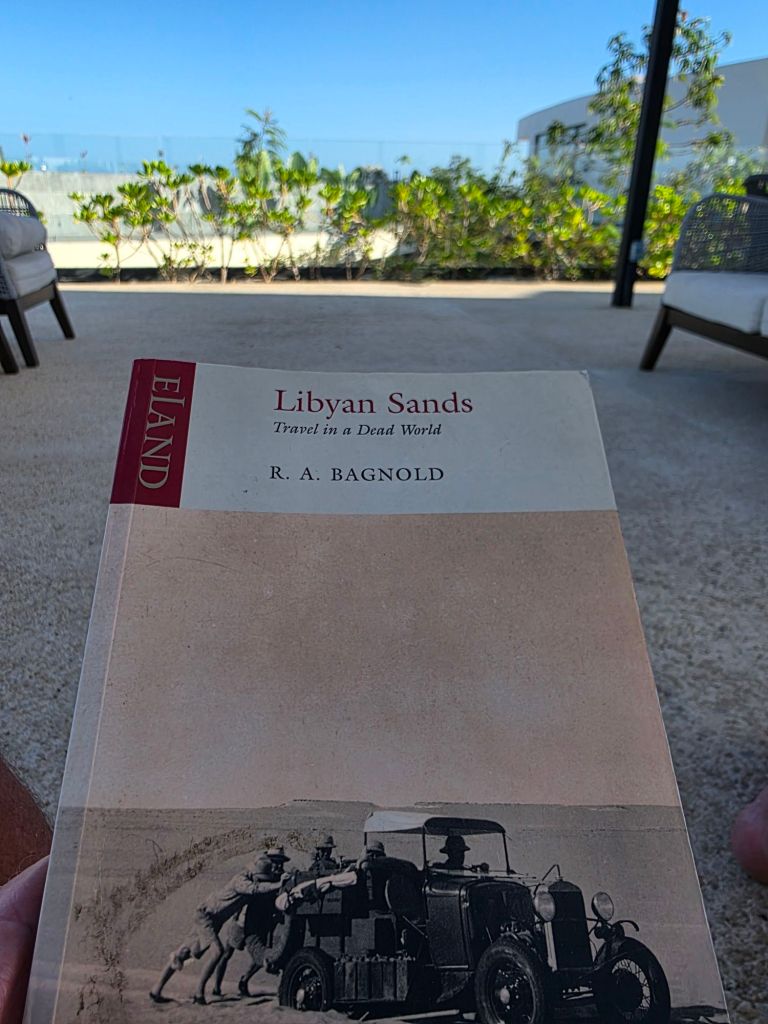
I’ve been reading a book for the second time. I first read it at university (I borrowed it from the head of department) and less than a week later, was publicly reminded to return the book to him via a department wide email, (“to the student who borrowed my book, please return it immediately”. The book, written by Ralph Alger Bagnold, is called Libyan Sands: Travel in a Dead World. It captures the quintessential essence of that high-bred English drive that led to the greatest empire the planet has ever, or will ever experience. Ralph Bagnold was one of those rare individuals who combined quiet humility, razor-sharp intellect, and genuine daring. The book is one of the finest classics of desert travel writing, blending adventure with scientific curiosity. Bagnold then went on to form the Long Range Desert Group (the precursor to the SAS in WW2) as well as develop a powerful scientific reputation (Penrose Award etc).
The Zerzura Club
Prior to this he and his pals formed The Zerzura Club. This was an informal group of desert explorers and adventurers dedicated to searching for the legendary lost oasis of Zerzura in the Sahara Desert.
The club was founded over pints in the Greek Bar in Wadi Halfa (a town in northern Sudan near the Egyptian border).
Searching for pussy paradise…
It brought together enthusiasts who had been pursuing rumors of this fabled “Oasis of the Little Birds” (Zerzura derives from the Arabic word for starling or small bird), described in ancient Arab manuscripts like the Kitab al-Kanuz (Book of Hidden Pearls) as a hidden, treasure-filled city or oasis with palms, springs, ruins, and even a sleeping king and queen in some accounts.
The group included notable figures such as the Hungarian explorer László Almásy (the real-life basis for the protagonist in The English Patient)
Others like Patrick Clayton, Hugh Penderel (nice daygame X handle – untaken), and Sir Robert Clayton-East-Clayton (excellent daygame X handle – untaken as well).
They conducted expeditions using early motor vehicles (like Ford Model A trucks) and even aircraft for reconnaissance, mapping vast uncharted areas of the Western Desert. While they never located Zerzura, their efforts uncovered real archaeological treasures, including prehistoric rock art and unknown wadis.
The club had a small membership of around 13 men and was more of a loose network of like-minded adventurers than a formal organization.
Chateau Hampstead
Reading the book, I couldn’t help note a small semblance to the Krauser/Bodi memoirs describing the “war years” of London Daygame in the old days. The Zerzura quest is course a nice comparative as to the spirit of man. Chateau Hampstead captured some of this essence – a collection of interesting men, strong minds and eclectic characters all thrust together fashioning ideas and behaviour.
I want the Zerzura Club spirit back. I will accept applications to join this small organisation of jovial intellectual raconteurs. It’s missing online. It’s missing in men. There are no innovators anymore. No interesting men who stare beyond the horizon. Just little weirdo twats who bathe in the slop of post-Tate/Tomasy Americanised brospeek, or the public shillartists that now dominate this once beautiful hidden space.
BroodingSea, March 2026
 Menu
Menu 
Leave a comment